
Industrial Control System Vulnerability Myths and Operational Reality
Operational technology security relies on physical constraints and process stability, not just network segmentation, making standard IT vulnerability models inaccurate for critical infrastructure.
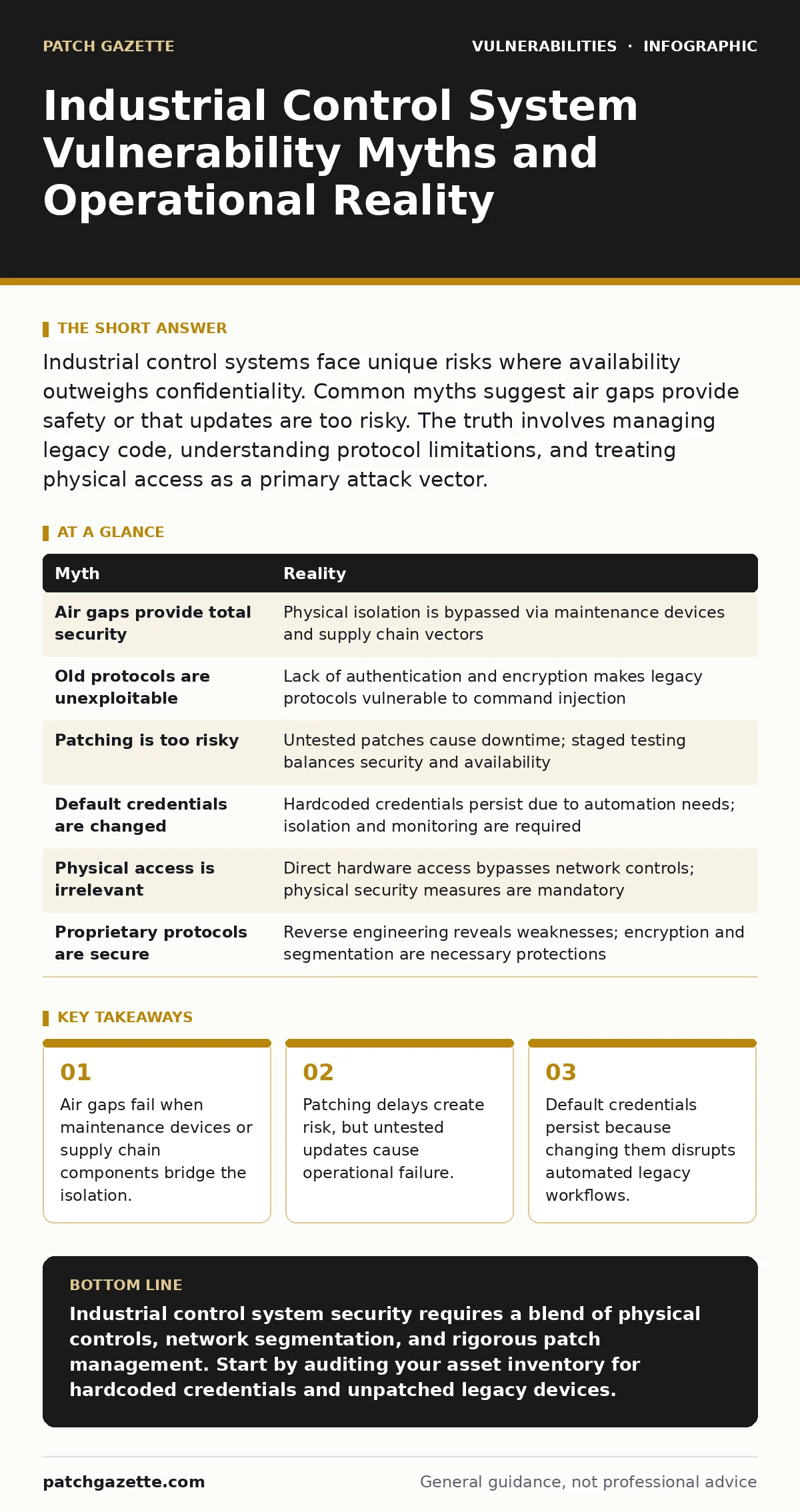
Industrial control systems face unique risks where availability outweighs confidentiality. Common myths suggest air gaps provide safety or that updates are too risky. The truth involves managing legacy code, understanding protocol limitations, and treating physical access as a primary attack vector.
Myth: Air-Gapped Networks Are Secure by Default
Reality: Physical isolation does not prevent data exfiltration or remote compromise. Attackers use maintenance laptops, USB drives, or compromised software updates to bridge the gap. The assumption that no network connection means no risk ignores human behavior and supply chain vectors. An air gap is a barrier, not a shield.
It slows down automated scanning but does not stop targeted intrusion. You must treat connected peripherals as potential entry points. Monitoring device usage and enforcing strict media controls are necessary. The isolation reduces the attack surface but does not eliminate it. Relying solely on physical separation leaves critical systems exposed to insider threats and compromised hardware.
Myth: Industrial Protocols Are Too Old to Exploit
Reality: Legacy protocols like Modbus or DNP3 were designed for reliability, not security. They lack authentication and encryption, making them vulnerable to replay attacks and command injection. Attackers do not need to exploit complex code flaws; they can simply send valid commands that disrupt operations. The age of the protocol is irrelevant to its exploitability.
The absence of security features is the vulnerability. You cannot patch the protocol itself without breaking compatibility with existing equipment. Instead, you must enforce strict access controls at the network edge. Network segmentation and unidirectional gateways help mitigate the risk. Understanding the command structure allows you to detect anomalous traffic patterns.
Myth: Patching Is Too Risky for Critical Systems
Reality: Delaying patches increases exposure to known exploits, but applying them without testing causes operational downtime. The risk is not just the vulnerability; it is the instability introduced by unverified updates. You must balance security against availability. Testing patches in a staging environment that mirrors production is mandatory.
This environment must replicate the hardware, software, and network conditions of the live system. Rolling back changes quickly is part of the strategy. You cannot assume a patch works because it works in an IT lab. Industrial systems have real-time constraints that IT systems do not. A failed patch can halt production lines or damage physical equipment.
Myth: Default Credentials Are Changed During Installation
Reality: Many industrial devices ship with hardcoded or default credentials that are difficult to change. Operators often leave them unchanged to avoid breaking automated scripts or remote monitoring tools. This creates a persistent entry point for attackers who know the default values. The convenience of default settings outweighs security in many operational cultures.
You must audit devices for hardcoded credentials during asset inventory. Where changing passwords is impossible, you must isolate these devices in restricted network zones. Access should be limited to specific management stations. Monitoring for login attempts with default credentials provides early warning. Ignoring this issue leaves a backdoor open to anyone with network access.
Myth: Physical Access Is Not a Security Concern
Reality: Physical access to control panels or engineering workstations bypasses most network defenses. Attackers can plug in devices, reset passwords, or install keyloggers. In industrial settings, maintenance personnel often have unrestricted physical access. This access is rarely monitored or logged. You must treat physical security as a primary control layer.
Locking cabinets, using tamper-evident seals, and restricting access to authorized personnel are necessary steps. Biometric or smart card access controls add layers of protection. Camera surveillance deters casual tampering but does not prevent skilled intrusion. Integrating physical access logs with security monitoring systems helps detect anomalies.
Myth: Proprietary Protocols Hide Vulnerabilities
Reality: Security through obscurity fails when attackers reverse-engineer proprietary protocols. Many industrial devices use custom communication formats that appear secure but lack cryptographic protection. Once the protocol is understood, it can be manipulated just like standard protocols. Attackers analyze traffic to deduce command structures and exploit weaknesses.
You should assume proprietary protocols are visible to adversaries. Implementing network segmentation and encryption at higher layers adds necessary protection. Do not rely on the uniqueness of the protocol for security. Regular traffic analysis helps identify deviations from expected behavior. Understanding the protocol allows you to create specific detection rules for intrusion prevention systems.
| Myth | Reality |
|---|---|
| Air gaps provide total security | Physical isolation is bypassed via maintenance devices and supply chain vectors |
| Old protocols are unexploitable | Lack of authentication and encryption makes legacy protocols vulnerable to command injection |
| Patching is too risky | Untested patches cause downtime; staged testing balances security and availability |
| Default credentials are changed | Hardcoded credentials persist due to automation needs; isolation and monitoring are required |
| Physical access is irrelevant | Direct hardware access bypasses network controls; physical security measures are mandatory |
| Proprietary protocols are secure | Reverse engineering reveals weaknesses; encryption and segmentation are necessary protections |
Key takeaways
- Air gaps fail when maintenance devices or supply chain components bridge the isolation.
- Patching delays create risk, but untested updates cause operational failure.
- Default credentials persist because changing them disrupts automated legacy workflows.
- Physical access bypasses network defenses entirely in many industrial environments.
Industrial control system security requires a blend of physical controls, network segmentation, and rigorous patch management. Start by auditing your asset inventory for hardcoded credentials and unpatched legacy devices.
Frequently asked questions
How do I detect anomalies in industrial protocols?
Establish a baseline of normal traffic patterns and use intrusion detection systems to flag deviations in command frequency or type.
How do I handle devices that cannot be patched?
Isolate them in restricted zones, monitor their traffic closely, and restrict physical and logical access to authorized personnel only.
How this guide was produced: written by the Patch Gazette editorial team with AI assistance, checked against the public references listed below, and reviewed when the facts change. See our editorial policy or report an error.