
CVE Monitoring Best Practices for Enterprise Security Teams
Effective CVE monitoring relies on contextual risk scoring rather than volume, turning noise into actionable intelligence for your engineering teams.
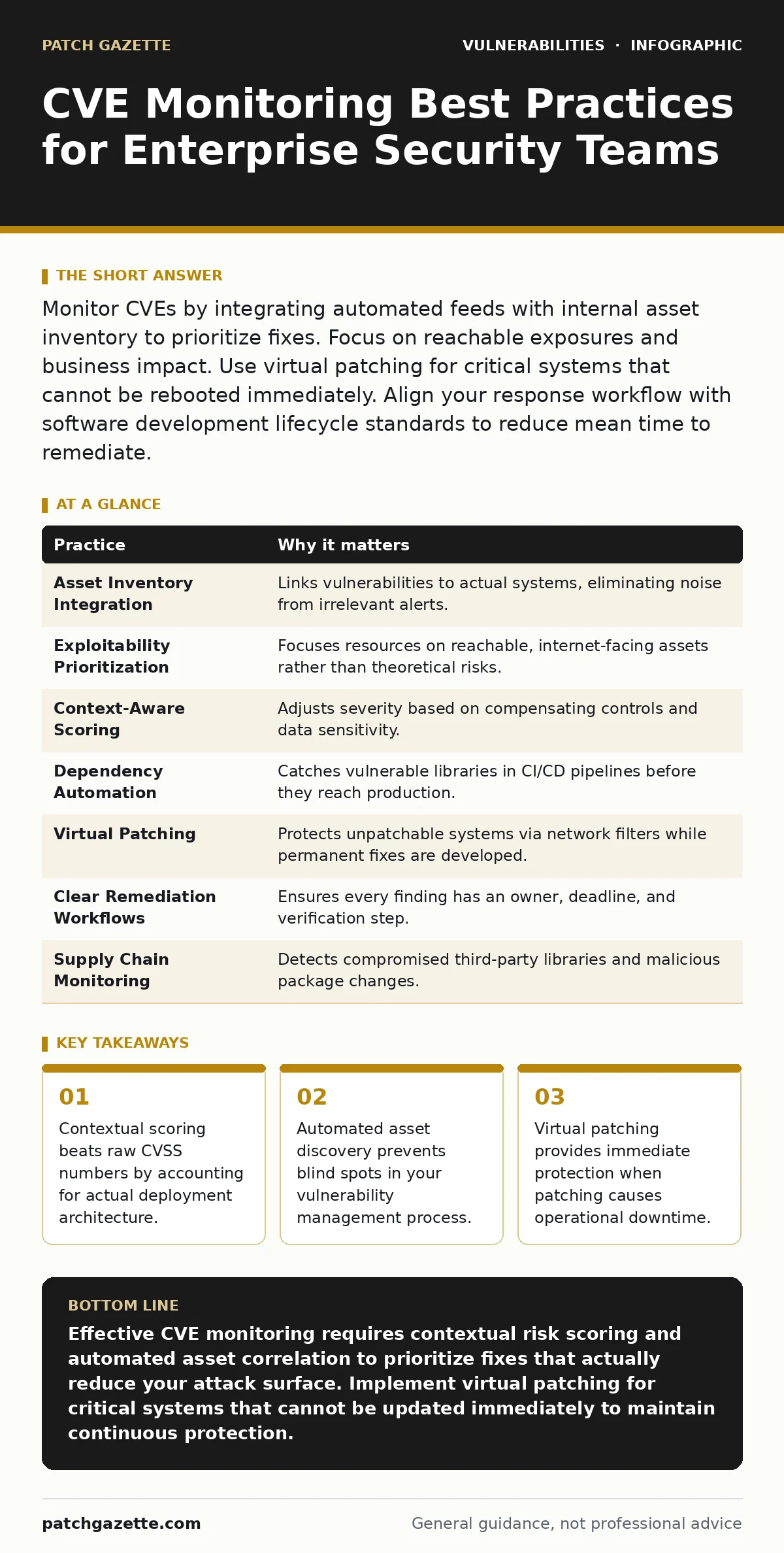
Monitor CVEs by integrating automated feeds with internal asset inventory to prioritize fixes. Focus on reachable exposures and business impact. Use virtual patching for critical systems that cannot be rebooted immediately. Align your response workflow with software development lifecycle standards to reduce mean time to remediate.
1. Integrate Asset Inventory with Vulnerability Feeds
Raw Common Vulnerabilities and Exposures data lacks context about your specific environment. A high-severity score means little if the affected component does not exist in your infrastructure. You must link external vulnerability intelligence with an accurate, real-time inventory of your hardware and software. Without this linkage, your team chases ghosts while real risks go unaddressed.
You need a single source of truth for what you own. Manual spreadsheets fail at scale because they become outdated within hours. Automated discovery tools scan your network and cloud environments to update this inventory continuously. This ensures that every alert correlates to a known asset with a specific owner.
2. Prioritize by Exploitability and Reachability
Not all vulnerabilities pose an equal threat. You must distinguish between theoretical flaws and those that are actively exploitable in your environment. Focus on assets that are internet-facing or accessible from untrusted networks. Internal-only services with strict network segmentation present a lower immediate risk. This approach conserves engineering bandwidth for the most dangerous exposures.
Reachability determines your actual attack surface. A vulnerability in a library used by a web server is critical. The same vulnerability in a library used by an offline backup script is low priority. Your monitoring system must understand network topology. It should identify which services can be reached by potential attackers and which are isolated behind firewalls or private endpoints.
3. Implement Context-Aware Risk Scoring
The Base Score in the Common Vulnerability Scoring System provides a standardized severity metric. It does not account for your specific deployment patterns or compensating controls. You need a mechanism that adjusts these scores based on your environment. This might involve lowering the priority of a flaw if a Web Application Firewall blocks the specific exploit pattern. Or it might raise the priority if the affected system holds sensitive customer data.
Context-aware scoring requires feeding additional data into your risk engine. Factors include the presence of multi-factor authentication, network segmentation status, and data classification levels. This dynamic adjustment ensures your prioritization reflects reality. It prevents the "alert fatigue" that occurs when every CVE-9.0 gets treated as an emergency.
4. Automate Detection of New Dependencies
Software supply chains change constantly. Your development teams introduce new libraries and update existing ones daily. Manual review of every change is impossible. You must integrate dependency scanning into your continuous integration pipeline. This catches vulnerable packages before they reach production environments. It shifts security left in the development lifecycle.
Automated tools check every commit against known vulnerability databases. They block builds that introduce high-severity flaws. This prevents the accumulation of technical debt. It also ensures that your vulnerability monitoring is proactive rather than reactive. You stop dealing with inherited risk and start enforcing secure coding standards.
5. Leverage Virtual Patching for Critical Systems
Some systems cannot be patched immediately. Legacy applications, medical devices, or industrial control systems may lack vendor support. Or they may require extensive testing before deployment. In these cases, virtual patching offers a stopgap measure. This technique uses network-level filters or application firewalls to block exploit attempts. It protects the system without changing its code.
Virtual patching is not a permanent solution. It reduces the attack surface while you work on a proper fix. You must document every virtual patch and its associated CVE. Regularly review these controls to ensure they remain effective against new exploit variants. Plan a timeline for actual patching or system replacement.
See our guide on vulnerabilities in industrial control systems for specific strategies on protecting legacy infrastructure that cannot be easily updated.
See also: Warning Signs of Medical Device Vulnerabilities in Healthcare Networks · CWE Weakness Categories: How Structured Classification Drives Security Decisions
6. Establish Clear Remediation Workflows
Detection is useless without action. You need a defined process for handling each vulnerability. Assign clear roles and responsibilities for triage, verification, and fix deployment. Set realistic deadlines based on risk severity. Critical flaws might require a fix within 48 hours. Lower-risk issues might have a 30-day window.
Your workflow must include a verification step. After applying a patch, confirm that the vulnerability is resolved. Automated scanners can verify this quickly. Document the resolution for audit purposes. This creates a closed loop in your security operations. It ensures that every identified risk is either fixed or formally accepted with justification.
7. Monitor for Supply Chain Compromise
Vulnerabilities often originate in upstream libraries. Attackers may inject malicious code into popular packages. This is known as a supply chain attack. Your monitoring must extend beyond your own codebase. You need to track the health and reputation of your dependencies. Sudden changes in maintainer activity or repository permissions can signal compromise.
Integrate tools that detect suspicious behavior in package repositories. Look for unusual commits or dependency changes. This helps you catch malicious typosquatted packages or vulnerabilities in PyPI packages before they impact your systems. Treat third-party code with the same scrutiny as your internal code. Verify checksums and signatures for all downloads.
8. Conduct Regular Gap Analysis
Your monitoring tools may miss certain asset classes. Shadow IT, personal devices, or cloud functions might operate outside your primary visibility. Regular gap analysis identifies these blind spots. Compare your asset inventory against security tool coverage. Identify gaps where vulnerabilities could hide undetected.
Schedule quarterly reviews of your monitoring coverage. Test your tools against known vulnerable test environments. Ensure they detect and report correctly. Update your configuration as your infrastructure evolves. This continuous improvement cycle keeps your defenses aligned with your actual environment. It prevents the slow drift where your security posture falls behind your technical reality.
9. Define and Track Mean Time to Remediate
Speed matters in vulnerability management. You need a metric to track how quickly you fix issues. Mean Time to Remediate measures the time from detection to resolution. Track this metric per vulnerability severity level. Identify bottlenecks in your process. Are approvals taking too long? Is testing delaying deployment?
Use this data to optimize your workflow. If critical patches take too long, investigate why. Automate testing where possible. Streamline approval processes for high-risk fixes. Reducing this metric directly lowers your risk exposure. It demonstrates operational efficiency to stakeholders. It proves that your security program is effective and responsive.
| Practice | Why it matters |
|---|---|
| Asset Inventory Integration | Links vulnerabilities to actual systems, eliminating noise from irrelevant alerts. |
| Exploitability Prioritization | Focuses resources on reachable, internet-facing assets rather than theoretical risks. |
| Context-Aware Scoring | Adjusts severity based on compensating controls and data sensitivity. |
| Dependency Automation | Catches vulnerable libraries in CI/CD pipelines before they reach production. |
| Virtual Patching | Protects unpatchable systems via network filters while permanent fixes are developed. |
| Clear Remediation Workflows | Ensures every finding has an owner, deadline, and verification step. |
| Supply Chain Monitoring | Detects compromised third-party libraries and malicious package changes. |
| Gap Analysis | Identifies blind spots in monitoring coverage for shadow IT or cloud assets. |
| MTTR Tracking | Measures and improves the speed of vulnerability resolution. |
Key takeaways
- Contextual scoring beats raw CVSS numbers by accounting for actual deployment architecture.
- Automated asset discovery prevents blind spots in your vulnerability management process.
- Virtual patching provides immediate protection when patching causes operational downtime.
Effective CVE monitoring requires contextual risk scoring and automated asset correlation to prioritize fixes that actually reduce your attack surface. Implement virtual patching for critical systems that cannot be updated immediately to maintain continuous protection.
Frequently asked questions
How do I handle vulnerabilities in systems that cannot be patched?
Use virtual patching to block exploit attempts at the network level. Isolate the system further with strict segmentation. Plan for eventual replacement or migration to a supported platform.
What is the difference between a vulnerability and an exposure?
A vulnerability is a flaw in software or hardware. An exposure is a vulnerability that is reachable and exploitable in your specific environment. Only exposures require immediate remediation.
Should I trust automated CVSS scores for prioritization?
Use them as a starting point only. Always adjust scores based on your asset inventory, network topology, and compensating controls. Raw scores ignore your specific context.
How often should I review my vulnerability management process?
Review your process quarterly. Update your asset inventory daily. Monitor for new CVEs continuously. Adjust your workflows based on Mean Time to Remediate metrics.
How this guide was produced: written by the Patch Gazette editorial team with AI assistance, checked against the public references listed below, and reviewed when the facts change. See our editorial policy or report an error.