How Network Address Translation Works: Mechanisms and Failure Points
Network address translation hides internal structure by rewriting packet headers, creating a stateful mapping that can break complex protocols if not handled with application-layer inspection.
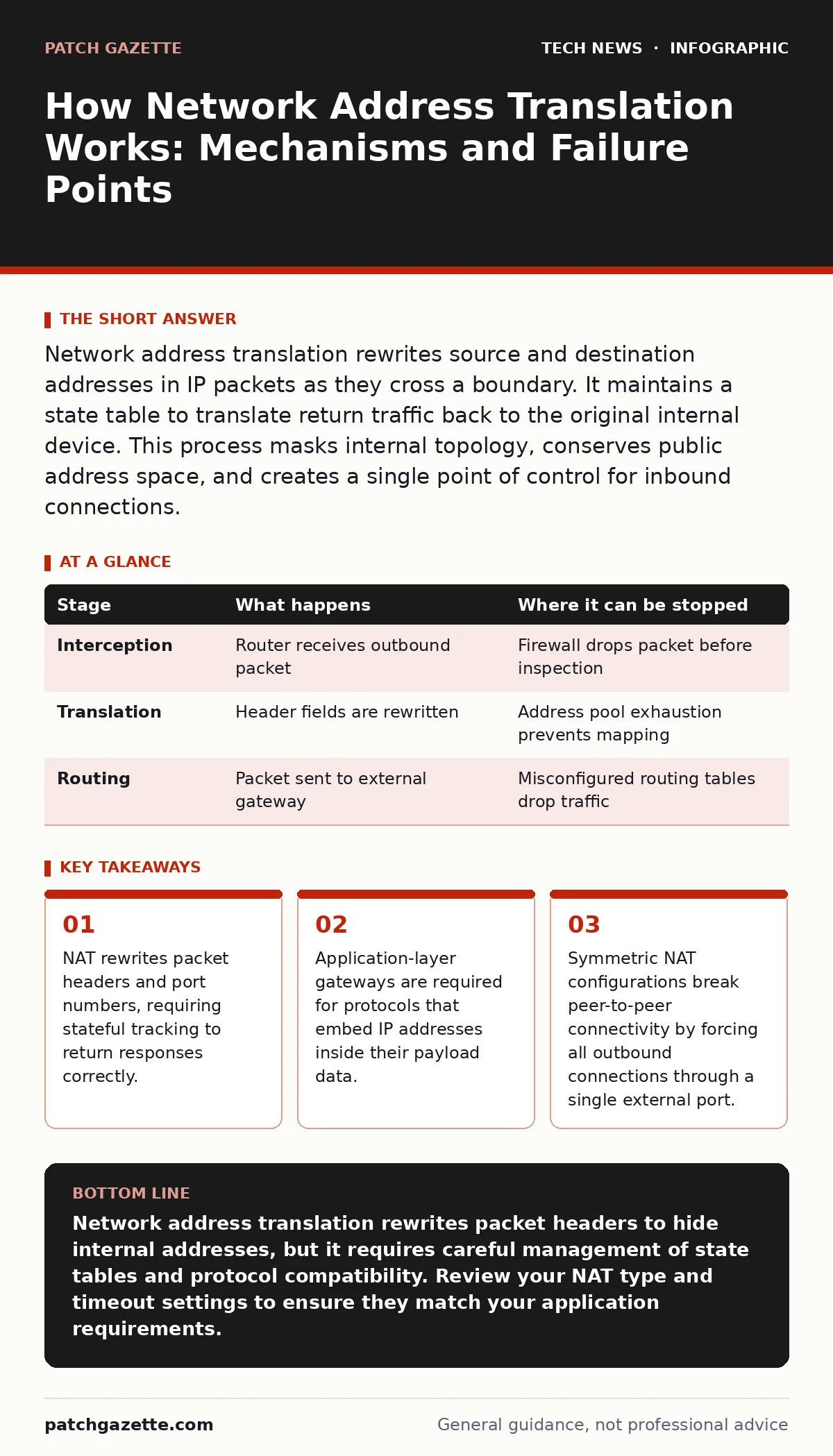
Network address translation rewrites source and destination addresses in IP packets as they cross a boundary. It maintains a state table to translate return traffic back to the original internal device. This process masks internal topology, conserves public address space, and creates a single point of control for inbound connections.
How network address translation works
Network address translation (NAT) modifies the header information of Internet Protocol packets while they are in transit across a routing device. You use this mechanism to map private internal addresses to a single public address or a small pool of public addresses. The primary goal is to hide the internal network structure from external observers. This obscurity prevents direct scanning of internal hosts. It also allows many devices to share one routable IP address. The device performing this translation maintains a state table. This table records every active connection. Without this record, return traffic would have no way to find its original sender.
The mechanics of address rewriting
The translation process begins when an internal device sends a packet to an external destination. The router intercepts this outbound packet before it leaves the local network. It reads the source IP address and the source port number. It then assigns a new source IP address from its own public interface. It also selects a new source port number if the original port is already in use for another internal connection. This new combination is unique. The router writes these new values into the IP header. It also stores the mapping in its state table. The packet now appears to originate from the router itself.
Stage 1: Outbound packet interception
The first stage occurs at the network boundary. An internal host generates a packet destined for an external server. The packet contains the private source IP address and a source port. The router receives this packet on its internal interface. It checks the destination to determine if translation is required. If the destination is outside the local subnet, the router initiates the translation process. It allocates a temporary public IP address and port. This allocation is temporary and tied to the specific connection. The router updates its translation table with this new mapping.
| Stage | What happens | Where it can be stopped |
|---|---|---|
| Interception | Router receives outbound packet | Firewall drops packet before inspection |
| Translation | Header fields are rewritten | Address pool exhaustion prevents mapping |
| Routing | Packet sent to external gateway | Misconfigured routing tables drop traffic |
Stage 2: State table creation
The router creates a record in its translation state table. This record links the internal private IP and port to the new public IP and port. It also records the external destination IP and port. This entry is crucial for the return journey. The router sets a timer for this entry. If no traffic flows for this connection within a specific time window, the router deletes the entry. This cleanup prevents the table from filling up. The table size is finite. A large number of simultaneous connections can exhaust this table. When the table is full, new connections are dropped.
Stage 3: External transmission and response
The modified packet travels across the public internet to the destination server. The server sees only the router's public IP address. It has no knowledge of the internal private address. The server processes the request and generates a response. This response packet has the router's public IP as the destination. It also uses the translated port number. The packet travels back through the internet to the router. The router receives this inbound packet on its public interface.
See also: Software Updates Best Practices: Secure Patching Without Downtime · Guest Wi-Fi Explained: Isolate Traffic Without Compromising Security
Stage 4: Inbound lookup and reversal
The router receives the response packet. It looks at the destination IP and port. It searches its state table for a matching entry. It finds the record created during the outbound phase. The router reads the original internal IP and port from this record. It rewrites the destination IP and port in the packet header. The packet now points to the correct internal device. The router forwards this packet to the internal network. The internal device receives the response. It believes it is talking directly to the external server. The entire translation process is transparent to the application.
Where translation fails or breaks
Network address translation is not transparent to all protocols. Some protocols embed IP addresses inside their payload data. Standard NAT only changes the IP header. It does not inspect or modify the payload. This causes a mismatch. The header points to the public address, but the payload still contains the private address. The receiving server rejects the packet because the payload address is invalid. This is common in protocols like FTP and SIP. To fix this, you need an application-layer gateway. This gateway inspects the payload and rewrites embedded addresses.
The impact on peer-to-peer connectivity
Symmetric NAT configurations create significant challenges for peer-to-peer applications. In this mode, the router assigns a different external port for each unique destination. If an internal device talks to Server A, it gets Port 1. If it talks to Server B, it gets Port 2. An external peer cannot guess which port to use to initiate a connection. The peer does not know which port the router will assign. This breaks direct connectivity. Solutions like STUN or TURN servers are required. These servers help peers discover their public mapping. They also relay traffic if direct connection fails.
Security implications and trade-offs
Many view NAT as a security feature. It provides obscurity by hiding internal addresses. However, it is not a firewall. It does not inspect packet content for threats. It simply rewrites headers. You must still use a stateful firewall to filter traffic. NAT can also complicate logging and forensics. Logs on the external side show only the router's IP. You must correlate internal and external logs to identify the source host. This adds complexity to incident response. It also makes it harder to audit individual user activity.
Managing connection timeouts and limits
The state table has a limited lifespan. Idle connections are removed after a timeout period. This is usually configurable. Short timeouts save memory but may drop legitimate long-lived connections. Long timeouts consume more memory and increase the risk of table exhaustion. You must balance these settings based on your traffic patterns. Some applications use keep-alive packets to extend the lifetime of the mapping. These packets reset the timer. If your application does not send keep-alives, the connection may drop unexpectedly. This can cause silent failures in background services.
Integrating with modern network standards
The rise of IPv6 changes the role of NAT. IPv6 provides enough addresses for every device to have a public one. NAT is no longer needed for address conservation. However, NAT still exists for other reasons. It provides a boundary for policy enforcement. It allows for centralized logging and filtering. Some organizations use NAT64 to translate between IPv6 and IPv4 networks. This ensures compatibility with legacy systems. Understanding these translation mechanisms helps you manage mixed environments. It also prepares you for the gradual shift away from IPv4 dependence.
Final considerations for network design
Designing a network with NAT requires careful planning. You must account for the number of concurrent connections. You must choose the right NAT type for your applications. Symmetric NAT is more secure but breaks many peer-to-peer apps. Full-cone NAT allows easier connectivity but exposes more internal state. You must also consider the impact on troubleshooting. Tools that rely on source IP addresses may fail. You need to configure your monitoring tools to handle translated addresses. This ensures you can track issues effectively.
Key takeaways
- NAT rewrites packet headers and port numbers, requiring stateful tracking to return responses correctly.
- Application-layer gateways are required for protocols that embed IP addresses inside their payload data.
- Symmetric NAT configurations break peer-to-peer connectivity by forcing all outbound connections through a single external port.
Network address translation rewrites packet headers to hide internal addresses, but it requires careful management of state tables and protocol compatibility. Review your NAT type and timeout settings to ensure they match your application requirements.
Frequently asked questions
Does NAT protect against DDoS attacks?
NAT limits the number of concurrent connections per internal host, which can mitigate some flood attacks. It does not stop volumetric attacks that target the router itself or application-layer attacks that exploit valid connections.
Can I configure NAT on a home router?
Most home routers perform NAT by default. You can usually configure port forwarding to allow external access to specific internal services. Check your router's manual for specific configuration options and security implications.
Why do some online games fail with NAT?
Many online games use peer-to-peer connectivity. Symmetric NAT types prevent direct connections between players. You may need to enable UPnP or configure port forwarding to allow the game to establish a direct link.
Is NAT required for IPv6 networks?
NAT is not required for IPv6 networks due to the vast address space. However, some organizations use NAT for legacy compatibility or to enforce policy boundaries between different network segments.
How this guide was produced: written by the Patch Gazette editorial team with AI assistance, checked against the public references listed below, and reviewed when the facts change. See our editorial policy or report an error.