Bug Bounty Triage Best Practices: Reduce Noise and Find Real Risks
Most bug bounty reports are duplicates or low-risk findings. Structured triage separates signal from noise by validating impact before assigning severity scores.
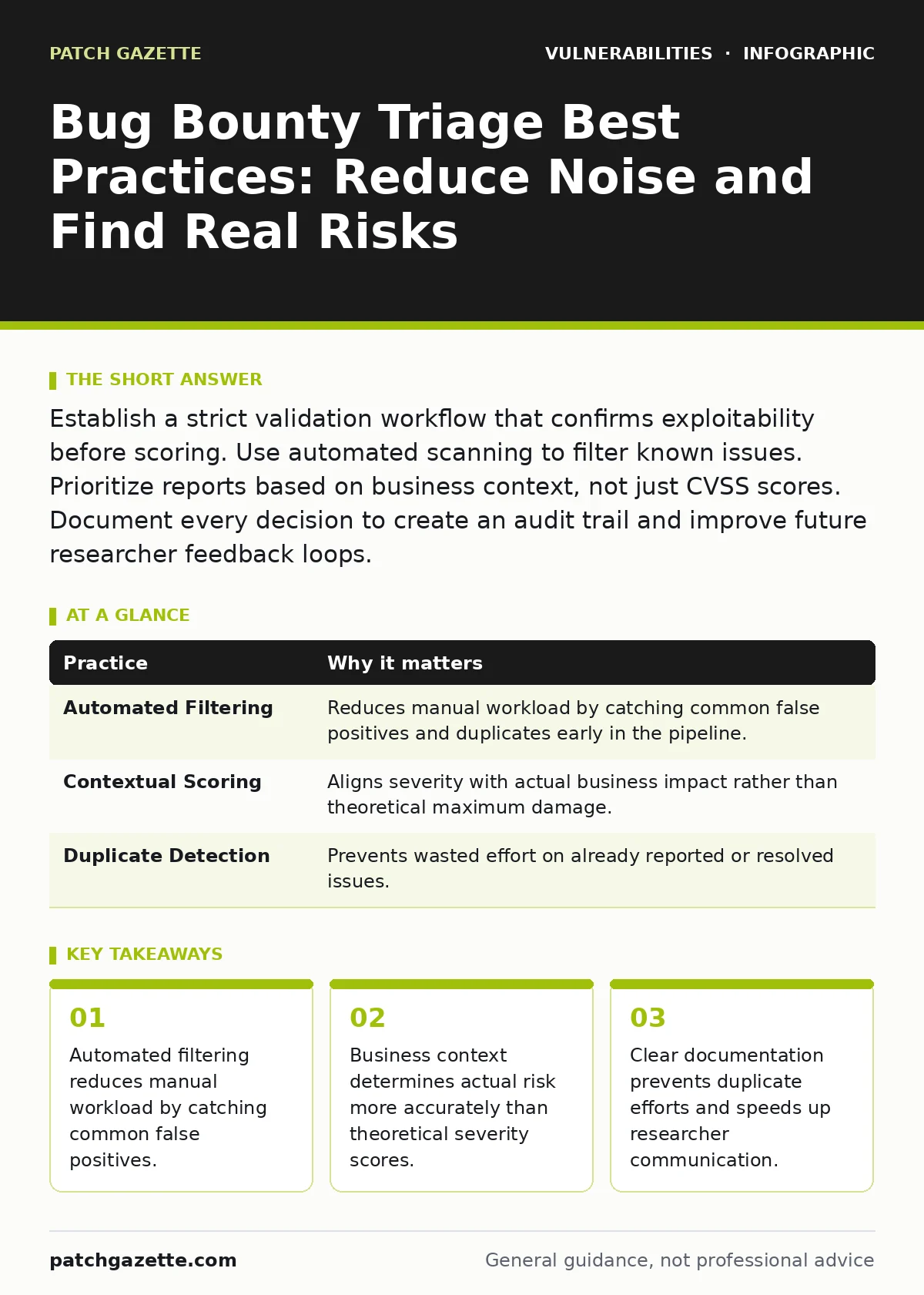
Establish a strict validation workflow that confirms exploitability before scoring. Use automated scanning to filter known issues. Prioritize reports based on business context, not just CVSS scores. Document every decision to create an audit trail and improve future researcher feedback loops.
1. Automate Initial Filtering for Known Issues
Manual review of every submission wastes time on obvious false positives. Automated tools scan for known vulnerabilities and common misconfigurations before a human sees the report. This step removes low-effort submissions that do not require deep analysis. You save analyst hours by letting scripts handle repetitive checks.
| Practice | Why it matters |
|---|---|
| Automated Filtering | Reduces manual workload by catching common false positives and duplicates early in the pipeline. |
| Contextual Scoring | Aligns severity with actual business impact rather than theoretical maximum damage. |
| Duplicate Detection | Prevents wasted effort on already reported or resolved issues. |
Tip: Configure your platform to auto-close reports that match known signatures or fall outside the defined scope. This keeps the queue clean for genuine findings.
2. Validate Exploitability Before Scoring
A vulnerability exists only if an attacker can exploit it. Many reports describe theoretical flaws that cannot be triggered in the current environment. You must reproduce the issue or confirm the conditions allow exploitation. Assigning a high score to a theoretical bug misallocates remediation resources.
Tip: Require researchers to provide proof-of-concept code or detailed steps that demonstrate successful exploitation. If the steps fail in your test environment, request clarification before proceeding.
3. Assess Business Context Over CVSS Scores
Common Vulnerability Scoring System (CVSS) metrics provide a standardized view but ignore your specific architecture. A high-score bug on an internal tool poses less risk than a low-score bug on a public-facing payment gateway. You must evaluate the asset’s importance and exposure. This contextual view drives better prioritization decisions.
Tip: Map each finding to the specific business function it affects. A bug in a non-critical marketing page requires different urgency than one in the authentication service.
4. Detect and Merge Duplicate Reports
Researchers often discover the same flaw independently. Without a robust duplicate detection system, your team reviews the same issue multiple times. This redundancy slows down response times and frustrates researchers. Consolidating reports ensures a single point of truth for each vulnerability.
Tip: Use keyword matching and endpoint analysis to flag potential duplicates. If two reports target the same URL or parameter, merge them immediately and credit all contributors fairly.
5. Communicate Clearly with Researchers
Researchers are your extended security team. Poor communication leads to frustration and reduced engagement. Clear, timely updates on the status of their reports build trust. You should explain why a report was accepted, rejected, or needs more information. Transparency encourages higher-quality submissions.
Tip: Set automated status updates for common stages like "Under Review" or "In Progress." Personalize rejection reasons to help researchers improve their future submissions.
6. Track Remediation Progress Internally
Triage does not end when a report is validated. You must track the fix through development and deployment cycles. Unresolved vulnerabilities remain active risks. Linking bounty reports to your internal ticketing system ensures accountability. This integration provides visibility into the full lifecycle of each finding.
Tip: Integrate your bug bounty platform with your project management tool. Automatically create tickets for validated bugs and update the bounty status when the ticket is closed.
7. Review and Refine Scope Regularly
Your attack surface changes as you add features and services. An outdated scope excludes critical assets or includes irrelevant ones. Regular reviews ensure researchers focus on high-value targets. This alignment reduces noise and increases the likelihood of finding significant issues.
Tip: Conduct a quarterly audit of your bounty scope. Add new public-facing services and remove decommissioned assets to keep the program relevant.
8. Analyze Trends for Proactive Defense
Bug bounty data reveals patterns in your security posture. Recurring issues in specific modules indicate deeper architectural weaknesses. Analyzing these trends helps you address root causes rather than individual symptoms. This proactive approach reduces the overall volume of future reports.
Tip: Generate monthly reports on the top vulnerability types. Share these insights with development teams to inform security training and code review practices.
| Practice | Why it matters |
|---|---|
| Trend Analysis | Identifies systemic weaknesses and informs long-term security improvements. |
| Scope Review | Ensures researchers target current, high-value assets rather than obsolete systems. |
| Internal Tracking | Connects external findings to internal remediation workflows for accountability. |
9. Manage Security Technical Debt Effectively
Not every bug can be fixed immediately. Some vulnerabilities require significant refactoring or architectural changes. You must acknowledge this security technical debt and plan for it. Ignoring known risks creates a backlog that grows unmanageable. Prioritizing fixes based on risk and effort balances immediate security with long-term stability.
Tip: Maintain a visible ledger of accepted risks. Review this list regularly with engineering leadership to secure resources for necessary refactoring.
Key takeaways
- Automated filtering reduces manual workload by catching common false positives.
- Business context determines actual risk more accurately than theoretical severity scores.
- Clear documentation prevents duplicate efforts and speeds up researcher communication.
Frequently asked questions
How do I handle a researcher who submits a duplicate?
Merge the reports immediately and provide a partial or full reward depending on your policy. Always acknowledge the effort to maintain a positive relationship.
What if a bug is valid but the impact is unclear?
Request additional information from the researcher. If the impact remains ambiguous, treat it as medium severity and monitor for any exploitation attempts.
Should I include third-party libraries in my scope?
Yes, if you host or serve them. Vulnerabilities in dependencies can lead to **dependency confusion attacks** if not managed properly. Ensure your scope covers all code you control or deploy.
How do I prevent scope creep during triage?
Stick strictly to the defined scope. If a researcher finds an issue outside scope, politely decline the report but offer guidance on what is in scope. This keeps the program focused.
How this guide was produced: written by the Patch Gazette editorial team with AI assistance, checked against the public references listed below, and reviewed when the facts change. See our editorial policy or report an error.